
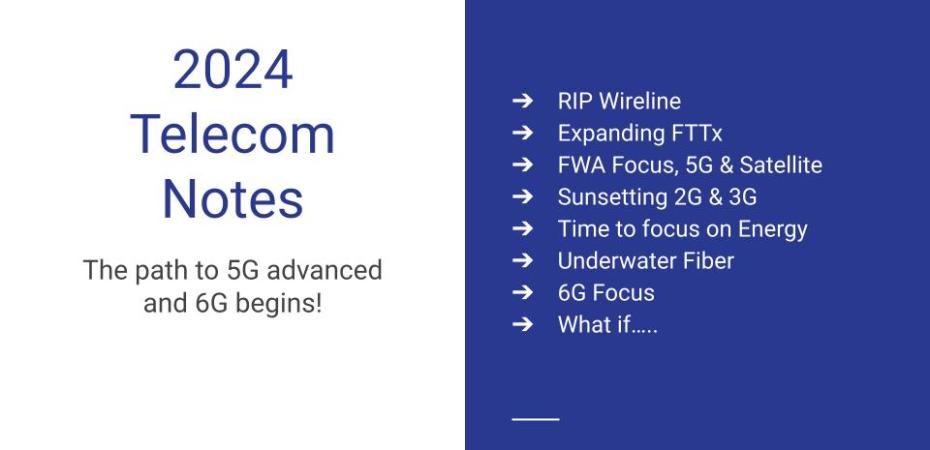
Reflecting on 2024 and looking ahead beyond 2025.
Wireleine has another nail in the coffin:
We see all the wireline companies finally trying to not only scale back but shut down these services. I don’t see it getting consolidated but the service is slowly being phased out. All this thanks to the ever improving wireless and internet access coverage across the USA.
While there is still a place for landlines, or is there? I believe not many homes want it and the generation that wanted it is finally migrating to mobile. I don’t know who uses them anymore except maybe antiquated businesses, like government offices.
Maybe some business and government offices will keep it around for emergency purposes. But soon it will get too expensive to pay for that in addition to your internet backhaul.
On the other hand, if you’re over 80 you may need it because you never got internet access. Like my in-laws. My mother-in-law, 83, has a mobile phone but her husband, 89, does not and insists on keeping the landline. To be fair, they both use the landline, which is mounted on the wall. The same place they mounted it back when the house was built around 1967.
How long will landlines be around? 10 more years maybe? Soon to be part of the good old days.
Fiber everywhere, thanks to the Feds:
Let’s face it, the BEAD funding heavily fiber over anything else. It wanted the infrastructure across the continental US to be in place. They purposely pushed aside FWA and satellite. I believe the Starlink is a viable solution, which the FCC did too after they initially rejected it.
While this bothered me at the time because of the financial models, I get it. They wanted something reliable and high speed. Something that a low budget WISP could not jump in and offer a half-assed solution then expect to get paid for it. It’s happened too often in the past.
So now we’re seeing how slow and expensive it is. On the other hand, it took an election to free up the funds in a timely manner. I can’t believe how long it’s taking. After the Chinese swap model, I thought it would have moved quicker. Unfortunately, history has repeated itself when it comes to government funding.
Internet everywhere with federal funding, at least for fiber.
Alternatively, Spacelink offered internet everywhere without the feds.
Satellite, LEO and Spacelink specifically, seems like a viable solution which the FCC snubbed initially only to come back and raise expectations later. Their mixed signals are somewhat frustrating to me. I hope they start to appreciate what it’s bringing to connectivity, not just in very rural America, but the world.
Wireless finally offers true FWA internet to the home, and the market is receptive!
While people are critical of 5G, the spectrum it forced the FCC to release has allowed carriers to finally offer a viable fixed wireless access (FWA) solution to the general public. We’re seeing speeds over 50 Mbps up and down, sometimes up to 1.1Gbps down. This is amazing!
I welcome this update because for the first time, the cable and fiber internet service providers (ISPs) finally have some real competition. All that talk about internet competition and cost competitive to the home was bunk because of the high price of running cables anywhere in America. All the permits, digging, delays, dig-one-policies, bureaucracy, and pain that companies endure, with or without fed and state BEAD grants.
While I give the carriers a lot of credit, specifically Verizon and T-Mobile, we can’t forget other technologies. Satellites using LEO (Low Earth Orbit) birds (satellites) have been another game changer. We finally can connect almost anywhere using a simple setup procedure and moderately small antennas. While it still isn’t “cheap” it’s quite cost effective. (Thank you Elon Musk!!)
Don’t get me wrong, I love my ISP in my home, but now I have options for when I travel or when I move. The old cable model is dying a wireline-type death. Unfortunately it will take my generation dying off to get to that point. So the current cable attached to the home model will slowly disappear after the 6G release.
Don’t get me wrong, we will have fiber for a long time to come.
Some of you may point to Wi-Fi, which is an awesome indoor solution, but it can’t go far. It needs backhaul which may be fiber or wireless. Pick your poison.
People are disappointed in 5G, but carriers are happy to sunset 2G and 3G, even though IOT providers are not.
While people are taking great pride in calling 5G a failure, I think it was a success. Could we continue with 4G, probably. But, 5G has opened up so many doors. The new spectrum, which the FCC released because of 5G, has opened the door to amazing breakthroughs of practical use cases. We have more solutions than ever, they just aren’t sexy.
I believe that 5G for the carriers has been a great success because they could finally shut down 2G and 3G almost everywhere. Think how all the IOT and legacy device users pushed back. They were not happy but it was inevitable that those devices would become obsolete.
The IOT makers now have less confidence in any of the carrier solutions lasting beyond 10 years. Remember that their devices are low cost. They’re lucky to get $50 for a device whereas a smartphone is rarely under $1,000. They are smaller companies and can’t do the R&D that Apple and Samsung can do. For them, it makes more sense to stick with Wi-Fi and LoRaWAN. Something cost effective where the legacy formats will work for many years to come.
Energy costs need to get under control!
One thing I think everyone can agree on is that energy costs are getting outrageous, especially over the last 4 years when all utility bills went up regardless of your usage.
What we need to do is use less energy in the data room. AI servers already promise to use way more energy, so much so that we will need to use nuclear power again. It’s to the point where we need to use small and efficient nuclear reactors everywhere.
We all saw with cryptocurrency mining how those servers used so much power. We should have seen the signs and acted then, but we continued to limit power resources.
Now we need to figure out how to turn up more power generation resources, and I don’t mean wind and cellular. The USA has plenty of natural gas and that is where we should start but let’s not take our eye off the ball and get innovative with small nuclear plants. We need it and the technology is so much better that it was 45 years ago when Three Mile Island melted down. We were scared then, but for some reason we never got back on track with innovation. Instead we had president after president push solar power. Unfortunately solar power is so limited that we need to add batteries everywhere. Lithium Ion batteries stations across the US don’t make me feel any better than small nuclear reactors. Pick your poison, huge battery banks or small nuclear plants.
However, OEMs of data and radio equipment need to make their power usage drop. I think that is where the next innovations should be. In fact, 6G standards should put energy efficiency at the top of their list. Oh, I don’t mean energy per bit, the OEMs used that during the 5G upgrades and it didn’t really help at all because bandwidth exploded. It also didn’t account for the routers, switches, servers, and cooling at the site.
Luckily now we have liquid cooled equipment, which I believe AI servers will heavily rely on. So many have already been out there but I fear they were ahead of their time. We need to continue pushing that technology and make it cost efficient compared to putting huge cooling units everywhere, from data centers to tower sites.
Underwater Fiber, can we live without it?
Remember when we relied on satellites for data? They had a lot of limitations.
Then we added fiber across the ocean and it was great. Unfortunately it gets cut more often than not. Not that satellites are any better since China created missiles that destroy satellites. So the imminent destruction is there regardless. The issue is a fiber cut in the ocean takes longer to repair, not to mention the insane cost of repair or replacement.
So maybe we can live without it but we need to find viable backups, which may be more fiber across more bodies of water.
What do we hope to see with 6G?
I am hoping 6G is less about the wireless format and more about the supporting network and the implementation of AI. While 4G and 5G have greatly improved the equipment behind the radio, 6G may push it past today’s limits.
I still don’t see the META thing happening. I feel Zuckerberg took the entire industry down a wasteful rabbit hole. When Facebook quietly migrated away from the Meta universe and into AI solutions, they began to progress again.
While domesticated Turkeys have wings, they can’t fly far. They can pull off the short trip, but that’s it. That is how I see the Metaverse. It didn’t fly far without a reasonable business case. Even the gaming universe didn’t adopt it in mass. Gaming already had their universes.
I am seeing 6G with more automation and self healing options than any network before it. That’s bad for a services guy like me, but we will still need support staff.
Telecom is in for an overhaul and the software will finally overtake the hardware solution in the next 10 years or so.
Today, telecom relies on the Cloud, the Edge, Internet access, fiber solutions, wireless backhaul, KPI monitoring, autocorrections, and so many more things running in the background. It’s incredible how much support has been automated. Yet, we still have outages and failures.
If the industry can focus on something other than another massive radio upgrade, maybe we can start looking at AI as the differentiator. It will be in every smart device, it will be in every core and RAN network. It will shape, improve, collect data, and hopefully improve our networks going forward.
With the AI bubble, it could also be the cause of great failures. That will be determined by how much regulation will tamp creativity around AI use cases. I think if we can let AI create network improvements on a mass scale, then it will become the productive partner we’re all grateful for.
I think 6G will be easier to implement with CloudRAN and OpenRAN in the mix. Moving forward we will be using CloudRAN almost everywhere. I also see OpenRAN being the new normal.
The use of servers in place of BBUs will become normal as we move into the next generation. The technology is maturing and is soon ready for primetime.
This will be 6G normal. As will AI in nearly every smart device and also in the servers and routers in the network. We will rely on machines making decisions more than ever. It may be good and bad until we tweak the settings properly. Remember that networks are always evolving, so we have to keep an eye on the evolution to ensure it’s evolving properly.
I also think backhaul will evolve. If wireless backhaul is to grow, then point-to-multipoint (PTMP) needs to be normal. Fiber and microwave jobs are point-to-point (PTP) which is very limiting. By using the cellular models we can start to distribute backhaul much as we would FWA. Sprint was doing this years ago before T-Mobile acquired them. That’s how they managed to build small cells for coverage. Pretty cool, right?
I think network and RAN sharing will become common, just not in the US between big carriers, but between small businesses, enterprises, and micro carriers.
Regulation and Evolution:
Most of you probably haven’t put together how heavy regulation affects innovation but it does have an impact. Usually regulation takes over when we have a commodity, or at least what is perceived as a commodity.
Farming and the products like wheat, oats, and corn. Milk, eggs, and meat are all heavily regulated. Oil, natural gas and propane. Add telecom to that list.
My perception is that it’s so heavily regulated that innovation is painfully slow and hard to break ground. Luckily AI, networking breakthroughs, Cloud technology, and things like that happened outside of telecom. They really should have happened in telecom. Unfortunately, it now happens somewhere else and telecom needs to integrate it.
The thing that sucks is when something like the Metaverse was announced all the telecom companies were all in without a thought or business case. I feel like it was a waste of time and money.
Did we learn our lesson? Probably not. That’s why I expect 6G to be an improved 5G, not innovative, just a slight improvement.
Let’s hope Silicon Valley has another breakthrough that telecom can steal.
What if….
Zuckerberg would not have made such a big deal about the Metaverse, then perhaps no one would have focused so much energy on it burning tons of telecom dollars on envisioning 6G with that crap in it. We went down so many rabbit holes with augmented and virtual reality, trying to pigeon-hole 5G into the solution. Step back and look at Wi-Fi as that solution because it’s easy, cheap, and already in every home.
When I look back at all the wasted time and energy trying to come up with a solution for an industry that just never took off, I get frustrated. We should have been focused on network improvements and useful business cases.
Summing it up:
I think the industry is repeating what it’s done for years. Exponential growth and then a serious downtime. Carriers are working to get payback. Newcomers have been continuously shut out.
When an industry is so heavily regulated by the government, it is hard for an entrepreneurial startup to break in with a new product. Telecom is that way.
Luckily, the internet is helping outsiders break in with new apps. Think Whatsapp and Zoom. They offered us alternatives on our devices outside of the traditional voice and text. They not only work but they’re very reliable.
We still text and call using our devices, but let’s face it, we now have choices and can reach people worldwide with few fees. I imagine the carriers hated it early on but they could not stop it.
Change is inevitable. Remember theses businesses?
- The long distance business? The competition? AT&T, MCI, and Sprint?
- The local long distance business? GTE, UTS, NYNEX, and all the Bell babies gauged us to call over 20 miles or so?
- Roaming from one carrier to another and all the charges that went with it?
- Paying for airtime by the minute?
- We paid for: call waiting, forwarding, voice mail, caller ID, data, per text, and more. All gone.
- commissioning and integration being done in one visit, onsite.
- Driving microwave paths?
- RF Engineering of paths?
- RF propagation studied?
- Applying for single licenses with the FCC that included all the coverage and interference predictions. We actually had to identfy the antenna types and cabling to the FCC with ERP predicitons prior to submitting th elicenses.
I also remember when the FCC had more engineers (which I greatly respected) than lawyers and policy makers. Oh, the good old days.
I love it because it shows how we’re evolving..
I hate it because it’s slowly forcing me to become obsolete and that breaks my heart. All I can do is the best I can with what I got moving forward.
 Smarter Tech Solutions
Great summary and future predictions. I would add that we may see private networks finally paving the way for industrial IoT solutions moving to cellular technology
LikeLiked by 1 person